A Motherhood Tale

For Women’s History Month, I’m devoting all my posts to things for women, about women, and spotlighting women. As motherhood is a unique experience commonly associated with womanhood and one that certainly defines a lot of things for anyone identifying as female, I thought I’d start here.

I always knew I wanted to be a mother. I was never one of those people that considered being childless by choice—except for that one phase in college when I was pretty sure I should be a nun, and I’m not Catholic. I’d always seen my life as pretty standard—married, children, job. In high school, (you know because 30 seems elderly when you are 16) I had this idea that I should marry at 20 and have a baby by 23 so I could be a young and cool mom. Funny how things turn out.

When I did not have a serious boyfriend to accomplish lofty goals with by age 21, the aforementioned plan was laid aside to die. Many would argue that marrying young and committing to that life is a lot to ask of a young woman who could be doing so many other things, but that was really what I wanted. I’ve never been one to want a field of boyfriends; my easily wounded (and slow to heal) heart just wanted it’s one person—my lobster (thank you Phoebe Buffay).

But life has a funny way of taking our best laid plans and turning them upside down while God chuckles on the side. So short story—met husband at 21. Engaged at 22. Married at 23. Mother at 24. Second child at 27. Mortgage at 28. The end.  Well clearly not the end, but as you can see, things went some kind of way and yet I wouldn’t change a thing, even if my 20s were entirely spent in a state of being overwhelmed and shell shocked.

I remember watching this show about babies and giving birth on TLC (before its content got all gypsy weddings, sister wives, and Duggars). It was about six weeks after our late November wedding; I was new to the area and sending out resumés. Instead of watching the show and wondering “if,” the idea was framed with a solid “when.” I thought we had a good three to four years before such things, though I remember kind of wishing our time was now. Because all that stuff was high theoretical that point in time.

Well….by the middle of March I was feeling like I was going die because something was definitely off. I was convinced there was no way I could be pregnant (hey kids—birth control is most effective when used 100% of the time. Ok? 100%), so surely, I had contracted something that was slowly killing me from the inside. I’d never skipped my period. Ever. But you know, I still didn’t believe pregnancy was a possibility (denial, denial).

My friend was about four months along in her own pregnancy and when I told her things had gone wonky in my world, she gave me a leftover unused prego test. I took it one fateful morning, and after the recommended time needed for the results to reveal themselves, I looked. I believe I was looking for a + sign. But I could only make out what I was certain was a – sign. So, I left the test in the bathroom and went about my business certain that maybe newlywedhood had just thrown me off temporarily. Ha ha ha.

When I went to throw away the test, I looked and saw a faint + sign. But somehow in my mind that registered as, “well it’s been sitting here a while, so the pee has seeped in and changed the sign to positive.” But still, I wasn’t pregnant. (Oh, sheesh girl, what I would tell that silly bride today).

Another month rolls by and another test is taken, which actually is negative again. Meanwhile I start a new job that I absolutely loathe, start feeling worse and worse (crying on the metro, dry heaving from the smells of the people on the metro). Finally, I decide to see an OB/GYN, because why not?

I cried in the waiting room while they got my paperwork together. When I sat down, my giddy husband asked what the doctor said, and when the words “She says I’m most likely pregnant,” tumbled out, so did the tears—from terror. He on the other hand was very pleased—with himself and the world.

We weren’t ready for this. Bleh apartment in a sketchy neighborhood, a job I hated and wanted to get out of but now felt trapped in, still adjusting to life in a new place I wasn’t sold on yet; and now we were going to be parents.

I was nearly 11 weeks along when I got my first ultrasound. All of the sudden the screen lit up with this image of a bouncy alien baby with E.T. eyes and a giant noggin. She was hyper—using my uterus as a trampoline and waving arm “nubbins” to say hello. The E.T. eyes were looking right at us as if to say, “Yeah, I’m real. See you soon suckas!”

Nausea, migraines, a gestational diabetes scare (I like that super sweet orange soda they give to be honest), horrific stretch marks, a whole lot of swelling, and husband that was so weirdly confident in our parenting abilities he said we didn’t need the birthing classes.

So, on November 6, 1999, I aced the birthing test without studying. But with drugs. And the drugs were good.

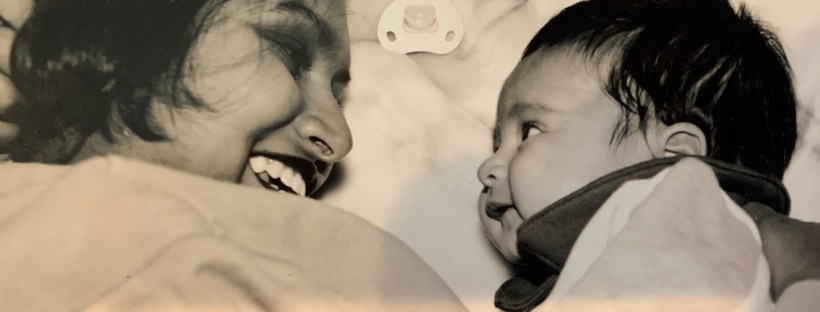
I wish I could say motherhood washed over me and made me whole the moment my child took leave of my body. The love was there. The pride that we made this pretty little thing was there. The sense of doing everything that needed to be done to care for her was there. I would feed, change, bathe, sleep, repeat.

But the ensuing 21 years of raising said child and the brother that followed have exposed my weaknesses. Anxiety and worry have always won out over reveling in the present. Motherhood opens you up and leaves you raw and exposed, and yet you don’t always know. And yes, the life of a child goes by very, very fast.

But motherhood—as it is brought to you through your own womb or that of someone else—is otherworldly. You look back at a grown child and think, “my word, this child has survived under my care.” And that’s where you come face to face with the grace of God. This job of bringing a life to the world through your own. This is the unexpected journey of twists and turns, boring stretches of the mundane; anger and sadness, hollowness and fullness and eventually the wistfulness that settles in when they finally walk toward a dorm building and so very, very far away from you.

It is all of it then. All of it now. All of what is still yet to come.

This post and exclusive content is also available on my podcast The WiloPod on Spotify.

There Is No Zen in Teaching Slavery

Today marks the conclusion of Black History Month. I sincerely hope this month has caused you to become more aware of the significant contributions of Black American leaders, innovators, educators, inventors, etc., that have built this country. I found social media particularly helpful with some accounts paying particular attention to historically significant Black Americans most of us are less familiar with.

If school systems national wide had any sense at all, Black History lessons have been front and center in February’s curriculum. And in my opinion, no, parents do not get the option for their kids to opt-out of Black History Month lessons, as was what happened at a school in Utah this school year. In a very challenging season in education, there have been many intrepid educators who have sought to teach lessons in more innovative and creative ways than in years past and there is much to be applauded. However, there are educators that make me wonder how they were ever entrusted with a license to influence the minds of children.

Case in point: the Caesar Rodney School District in Delaware is currently investigating a situation where a kindergarten teacher incorporated yoga into her teaching of slavery and the Middle Passage. Buckle your seatbelts folks, your jaws are about to hit the floor.

The teacher in question is likely aware that yoga is a helpful tool for young children to exercise, learn focus, and calm their emotions. A wonderful activity for P.E. or quiet time. This teacher was wise to believe her Kindergarteners would be well served to learn about the crime of slavery and its role in the building of the United States from that young age. But she put the two together. And it was. … no. Just no. As the children were learning virtually, a parent was able to record the “lesson” and posted it to Facebook, much to the horror and disgust of parents and all non-racists.

According to this report in delawareonline.com*, the teacher combined yoga poses with her version of how Africans were kidnapped, enslaved, and brought to America. I’d like to emphasize “her version.”

“’ African people came to America on boats to become slaves,” the teacher says in the video. So, here’s the great big country of Africa. They crossed the Atlantic to come over to America. So right now, I need you to get into your boat pose,’ she says, demonstrating the yoga post.”

Let’s unpack this, shall we? (I can feel my blood pressure rise as I write this). 1. African people came to America on boats to become slaves. More like human trafficking and robbing human beings of their agency. 2. This great big country of Africa. Africa is a continent comprised of countries. How did this teacher get past elementary school not knowing? And she got a teaching certificate? But then again, most Americans are notoriously pathetic at basic world geography—that has been well documented. 3. Get into your boat pose, so the children can understand exactly how enslaved people were trafficked to America. This teacher knows nothing—nothing about the truth of how human beings were forced to American shores and being treated worse than animals in utterly horrific conditions. Questions? Just read Alex Haley’s well-researched account in his classic, Roots. How anyone survived that is evidence of superhuman strength. So no, not quite the same as balancing in boat pose while focusing on some light inhalations and exhalations.

But wait. There’s more.

“’ Africans were treated very poorly, even though they farmed the land and plowed the fields to make America beautiful and help grow our food,’ the teacher continues. ‘They worked in the fields all day. If you’re at home, you can try the plow pose.”’

Wow.

Africans were treated very poorly, even though they farmed the land and plowed the fields to make America beautiful and help grow our food.

Yes, treated poorly. Farmed and plowed. No mention of overseers standing at the ready to whip a slave at whim, or that children were bred by masters to increase productivity and monetary value and said children could be torn from their mothers to be sold off, abused, and murdered.

But I hear where some might say, “She was teaching kindergarten students. She can’t talk about those things so she had to speak in language they could understand.” As a parent, I completely understand age-appropriate language, tone, and delivery in teaching children. But children are much more capable than we give them credit for in understanding difficult things. So much so, they often develop more empathy and righteous indignation in a way adults seem to miss altogether.

Children can be told that white people kidnapped African people because those particular people were mean and hateful. They know that kidnapping is wrong and very scary. We have taught them that well by the age of five and six. Children can be told that people were beaten and hurt very badly. They can be told that slaves had chains put on them and it hurt them. They can be told that the ships that brought them to America were not Royal Caribbean cruise ships with waterslides. They can hear about and understand the terrible conditions enslaved people endured in the passage. They can be told that working in the fields was hard and painful work and that enslaved people were hurt by mean people, that their families didn’t get to stay together, and that they were hungry, cold or too hot, and scared.

These are hard but understandable facts kindergarten children can digest. And comprehending this can go a long way toward helping them reject racism, inequality, and violence long before many think they are capable of doing that.

And no, yoga has no place whatsoever in the presentation and dialogue of these difficult but necessary truths of American history.

What in the world was this teacher thinking?

* https://www.delawareonline.com/story/news/2021/02/26/delaware-school-district-investigating-unacceptable-black-history-month-lesson/6834627002/?fbclid=IwAR3ei8yqQQu1CwfunMeDFVUaXqIkhi9LfcY59bgcq9rU2BBKoCwNrjxSBdE

Twenty Questions With Me

So this is a post purely for fun. Feel free to copy and paste these questions for your own blogs or to ask people you are getting to know. If you resonate with any of these questions or answers, drop me a comment. I’d love to hear from you!

Ok! Let’s go!

1. What’s your favorite way to spend a day off?

Sleeping in and then taking my time getting out of bed to read, watch Tik Tok, etc. Then eat an easy breakfast, get a workout in and do more vegging. Honestly I’ve forgotten what a day out and about feels like that doesn’t involve risking your life because of exposure to pandemic people. Check back with me in a year.

2. What type of music are you into?

I really like everything. Seriously. Country music for the storytelling, my 80s Duran Duran and Euro pop, 60s music, 90s Hip Hop, even the stuff my kids listen to that makes me cringe with the bad words.

3. What was the best vacation you ever took and why?

Paris, France. It was a surreal dream come true. I just never thought I’d be there and then my husband arranged for a day touring the beaches of Normandy and the American cemetery. And since I’m a huge history nerd, I was in heaven. Also Paris is one city that lives up to every bit of the hype. Morocco is a close second. Another surreal place. We watched the sunrise over the Atlas mountains in a hot air balloon. I’m so grateful.

4. Where’s the next place on your travel bucket list and why?

Right now anywhere I can fly to. This is going to sound awful, but Poland to visit Auschwitz. Because of my WWII history nerd self. We were actually booked to go last summer. But then you know, global pandemic.

5. What are your hobbies, and how did you get into them?

Reading, baking, creative stuff like blogging and coloring in my adult coloring book. Yup, I have one. All of those things just came upon me. I don’t really remember a definitive moment that got me to start.

6. What was your favorite age growing up?

I was an 80s child. So, 8-12. That was a great era to be a kid/teen. Toys, TV shows, fashion. It really was fun. I think being a teen in the 90s was a bit of let down.

7. Was the last thing you read?

Currently reading Clanland by Sam Heughan and Graham McTavish from Outlander. Obsessed with that show and of course, Scotland is another must-go for me now.

8. Would you say you’re more of an extrovert or an introvert?

My personality tests actually say I come way down the middle and can go either way. But the older I get, I feel more introverted.

9. What’s your favorite ice cream topping?

Whipped cream and something crunchy.

10. What was the last TV show you binge-watched?

OUTLANDER! Highly recommend. I’m now going back to favorite episodes. Ahhh so good.

11. Are you into podcasts or do you only listen to music?

I love a good podcast. I love listening to them when taking or walk or driving, probably even more than music.

12. Do you have a favorite holiday? Why or why not?

I don’t. I’m actually not even all that into Christmas to be honest. I don’t like how hyped you get leading up to one and then the crushing let down and brutal return to routine life when it’s over.

13. If you could only eat one food for the rest of your life, what would it be?

Gosh–I’d get sick of only one food like that. I need variety.

14. Do you like going to the movies or prefer watching at home?

I prefer watching at home to be honest.

15. What’s your favorite sleeping position?

On my left side.

16. What’s your go-to guilty pleasure?

Watching Tik Tok videos. I’ll never make one though.

17. In the summer, would you rather go to the beach or go camping?

Beach!! All day every day! I’m a water baby and love swimsuits and being in water.

18. What’s your favorite quote from a TV show/movie/book?

“Whats-a happening, hot stuff?” Sixteen Candles–but honestly there are so many gems from that one.

19. How old were you when you had your first celebrity crush, and who was it?

Seven or eight. Bruce Lee when I saw him in Enter the Dragon–was loitering around the big kids.

20. What’s one thing that can instantly make your day better?

A relaxing, soothing massage.

Well, there you have it! I’ll probably do this again from time to time. So post your own questions to me if you want!

Protect Our Asian-American Community

A week ago, my niece sent me an Instagram screenshot of my favorite bubble tea spot in the area. Bubble tea: If you know, you know. Anyways, she told me that Kung Fu Tea in Columbia, Maryland had been looted and vandalized along with two other Asian-owned businesses in the same block. And all of this happened on the Lunar New Year, or Chinese New Year. Kung Fu Tea is literally a homing beacon to me—it calls me to it at least once a week. It’s a spot that people of every nationality imaginable patronize in our city, and we have collectively kept it alive even during this pandemic. The other two establishments that were hit are also never at a loss for business. These places are as much a part of the community as any other spot.

This is just one more incident of racist, idiotic violence against a community in a rash that has swept the nation for many months. Is this new?

Of course not. Chinese workers built our railroads, in case anyone is unclear on that. But do you think they were treated with even a smidgeon of respect for a job that literally linked the entire nation for the growth of commerce and settling all 50 states? No, they were barred from nearly all aspects of life in America, hence the growth of Chinatowns in basically every major city in the country.

Did you know that Japanese immigrants were not allowed to become United States citizens until 1952? It was not until 1965 that the ban on immigration from Japan and other Asian countries was lifted. You of course are well familiar with Japanese Americans being incarcerated in camps during the war—losing their property and livelihood—which some never regained. All this while entire squads of Japanese American soldiers still fought for the United States while sending letters home to families living in squalid wooden sheds in the most desolate and unwelcoming places the country could find for them.

None of this racism, marginalization, and violence is new. Indeed, for any non-White American, encounters with racism in its many vile and disgusting forms is a part of our story.

But just as all Americans and friends of Americans who abhor racism in totality have spoken up for other groups, we have to speak out and expose all perpetrators of crimes against Asian-Americans from coast-to-coast. Incidents have indeed ratcheted up due to the pandemic and the small-minded notion that harming an Asian person will suddenly eradicate the virus and bring back the ‘Murica of yesterday.

I mean really. What kind of low-life idiot clearly lacking brain cells feels like these acts of stupidity somehow make them more powerful in their sad assertion of white supremacy? You know, because attacking elderly Asian people is a sign of strength.

To me, it’s pointless to attempt to sway the misled viewpoints of people like this. Physically harming someone’s grandma or grandpa? Randomly beating up on Asians walking down the street. Vandalizing and looting Asian places of business? Yeah, you’re accomplishing so much. Don’t worry, you’re Medal of Freedom is coming in the mail. Please.

So, here’s what we can do:

Support Asian American businesses. In the United States in 2021 if you aren’t familiar with Chinese, Korean, Thai, Japanese, Vietnamese, etc., food, please send me a picture of the giant rock you live under. For the rest of us, indulge all your noodles, sushi, pho, pad thai, cravings. And get all the bubble tea you want with my blessings.

Seek out Asian owned spots in your town and give them some business. If you’ve got an H-Mart or some Asian market in your area, go get your produce from there—it’s cheaper, fresher, and loaded with more variety than your regular grocery store. And if you’ve always wanted to try out some Asian recipes at home, you simply must go to the source.

Speak out. Don’t stand for stupid jokes and stereotypical remarks from anyone in our circles—family included. Literally tell people to stop being idiots. And walk away.

If you see something, say something (and do something). I know this can be a risky one. Because obviously the folks being cruel to people of other races aren’t right in the head. But you can quickly come to the aid of persons being harmed and help them move quickly to safety, draw attention from others around you, or flat out walk up with your phone in hand and 911 dialed, letting the dummy know you’re not playing. Whatever you can do, do it. Don’t just walk away feeling bad, or worse, indifferent.

Collectively, we can stand together to be a voice for people who need us. There are more good people in this country that aren’t wackadoo crazy (even with the events of January 6 and Ted Cruz in Cancun) than you might  believe. Sometimes we all need a push to have the courage to do what’s right. But by being that person who steps out, your example just might be giving someone else the strength to join you. And in the end, it will make a difference.

Pure as Purel

Purity culture is a term that refers to a movement, if you will, born of the 90s in evangelical Christian circles, though certainly not limited to them. This movement, which completely ignores LGBTQ individuals, took special aim at trying to return girls and young women to the days where females were judged good or bad based on chastity. Plainly put, the job of a good female was to remain a virgin until her wedding night, and during her growing up years to maintain modesty and decorum in dress and behavior at all times. Now this is also something most patriarchal cultures outside of religion hold at a high premium—a daughter whose marriageability is dependent on her “unsullied” past and innocence in the ways of sexuality.

In the United States, many Christian denominations take purity culture to all kinds of levels—father/daughter balls where a young girl publicly pledges the keeping of her virginity until marriage, to her father in exchange for a purity ring to be surrendered on her wedding day (a bit creepy if you ask me). There were books (who remembers I Kissed Dating Goodbye? Yeah, that author has rethought that project since), conferences (where teens who’d done the deed cried in public confessions in sports arenas), pacts between groups of young girls in their church youth classes, purity pledge cards, etc.

Essentially, purity culture taught girls that chastity before marriage was a holy ideal that was to be valued above everything else. EVERYTHING else.

Is it bad to remain a virgin until marriage? No, of course not. The truth is, going that route is 100% effective in preventing unwanted pregnancy, contracting SDIs, and saving oneself emotional and self-worth issues (especially for those not mature enough to handle a sexual relationship). However, that idea isn’t as commonly accepted as it once was, thus society has indeed moved the goal posts. And it’s because of that shift that purity culture was born, but here’s how it does damage.

  1. Purity culture puts an unfair amount of responsibility on the female alone. On a foundational level, it asserts that the female body exists solely to please a man. Thus, a young woman is pretty much a temptress whose physical beauty and “parts” for lack of a better word, must be guarded at risk of bringing shame upon herself, her family, and her faith, should she “slip.” The role of the male in all this places them as nothing more than hungry fiends ready to pounce, and a “good” girl is always in defense mode.
  2. It breeds a crushing atmosphere of guilt, shame, and fear; almost certainly guaranteeing hypocrisy and disillusionment.
  3. It places all sense of self-worth on sexuality and virginity, so that if those things are compromised, a person amounts to nothing. Anyone heard the chewed-up piece of gum analogy? Lots of young women even today have been shown a lovely, fresh piece of gum. But when the gum is chewed and spat out, they are asked if anyone would want that used gum. Girls who have sex before marriage are chewed pieces of gum.
  4. It warps a person’s concept of being loved and valued by God just as they are, and in an ironic way, blames God. How? For a group of people who believe firmly in the flawless creation of humanity by a master designer God, the female body appears to be a problem. In its beauty and alluring nature, God, it turns out, made something no more than a troublesome, loaded weapon.
  5. Purity culture provides fertile ground for low self-esteem and mental health issues. When shame, guilt, and fear are primary motivators all connected to a physical body, how exactly are young women (and men) supposed to transform into well-adjusted marriage partners with healthy attitudes toward sexuality?
  6. It can push forward a completely warped version of the female body to the point where girls are so ashamed of what is natural, they will not seek medical help for issues that arise.
  7. It can actually feed into rape culture, by causing a young person to feel that their actions or dress sent “messages” that got them what they “deserved.” Wearing a short skirt? She asked for it. This goes dangerously further in that a young person may feel so ashamed of their perceived failure they stay silent, failing to see sexual assault for what it really is: an act of violence and dominance by a sick person.

I think many parents can agree on wanting their children to remain safe from disease, feel emotionally secure and confident, and enter parenthood on their own terms at the time that is right for them according to their personal values. But what is so important is to teach kids to see that the responsibility for treating oneself with the utmost respect lies on both boys and girls, however they identify. Full autonomy over their bodies is their right. And right up there with that is the need to reinforce the truth that the beauty a person possess’ inside and out can’t be removed by losing one’s “purity.”

It is a tough world out there. And we do well to be careful, discerning, and smart in our decisions. But there are better ways to help young people make smart choices for themselves that do that don’t meld fear mongering with emotional, spiritual, and mental manipulation.