Tok Around the Clock

When everything started shutting down last March, Tik Tok was barely on my radar in terms of preferred social media. Tik Tok was decidedly my high school aged son’s thing. But one year later, 40-something moms have arrived! Ok they are there, but that’s not the point of this post. I must preface this by saying while I do have an account, I only have one so that I can like and make comments (always affirming, I don’t do that mean trolling crap). You will never see me in videos of my own creation. That is my promise to you. But for all you Tik Tok creators, keep doing you! BECAUSE I LOVE IT!    

Almost a year into quarantine, Tik Tok has become a part of my life. That’s right. I’m saying it. And while my family thinks I have an addiction to it and can’t control myself, you tell me. Does someone who is addicted designate a specific time of day to look at Tik Toks, then and only then, without interrupting the flow of the day to “cheat” the schedule? Yeah, I thought so. I do set aside the time after I log off work for the day and before I have to cook dinner, as Tik Tok Wind Down time.

Sure, back in March 2020, Tik Tok was a place to find families doing all those dance challenges (Savage anyone?). And yeah, they were pretty funny and nice escape from mess 2020 was quickly becoming at that time.

But over the course of the summer, the lead up to the elections in November and through to now, Tik Tok evolved from this kind of silly social media platform to a legitimate space for learning just about anything. Thanks to the algorithm, Tik Tok is pretty good and feeding me content that I actually care about (Nope, I have not found myself in Trump Tok, thank you Lord). Of course, algorithms are determined by the level of interaction one has with specific accounts (at least that’s how I understand it), so what I’m shown is pretty predictable if you have any sense of my interests.

That said, I’d like to share some of my favorite Tik Tok creators, whom I follow for a variety of interests they address. After several of my more serious posts, I thought lightening up to share some great accounts to check out would be a good thing.

So herewith is my collection of Tik Tok that is more than just pandemic entertainment.

Food

This category has a two-fold purpose. Easy and tasty recipes (got my best Shawarma Bowls recipe from Tik Tok) and DMV (DC, Maryland, Virginia) spots to check out. When there is nothing to do besides go for a drive to pick up takeout, recs from people in the know are extremely helpful. It also makes for great exploration of your locale.

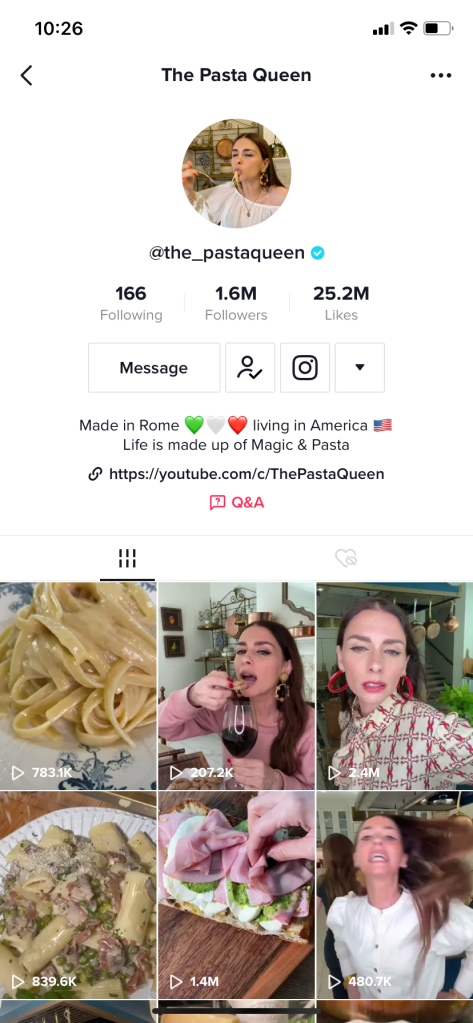
Italian food the way Italian people make it in Italy. Nuff said.
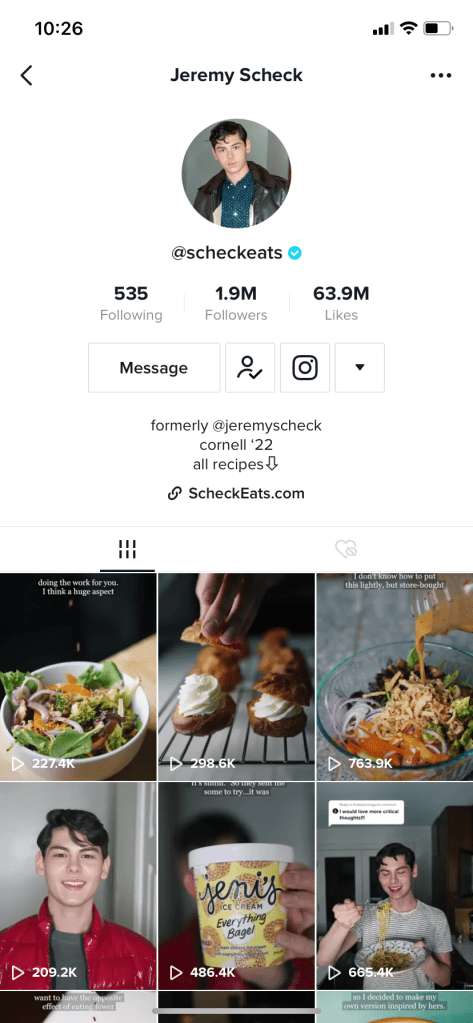
A foodie from Cornell University who knows his way around a kitchen–both at home with his parents and on a budget at school.
Her recipes are delicious! She also seems to live a pretty charmed life in the hills of LA. Fun to watch, fun to cook.
Come for the Chai (chai means tea. stop ordering chai tea lattés. you’re only saying “tea tea lattés.) stay for the hope.
Where ever you live, someone has an account about food treasures in your zone.
This DMV foodie has the deets on great spots to try. (I was so tempted to say deets on eats!)

Wellness

These are actual board certified medical and nutritional professionals who dispense real science and logic. No, they aren’t there to diagnose your issues online. But you can learn a lot from their content which has proven to be super helpful to me, personally.

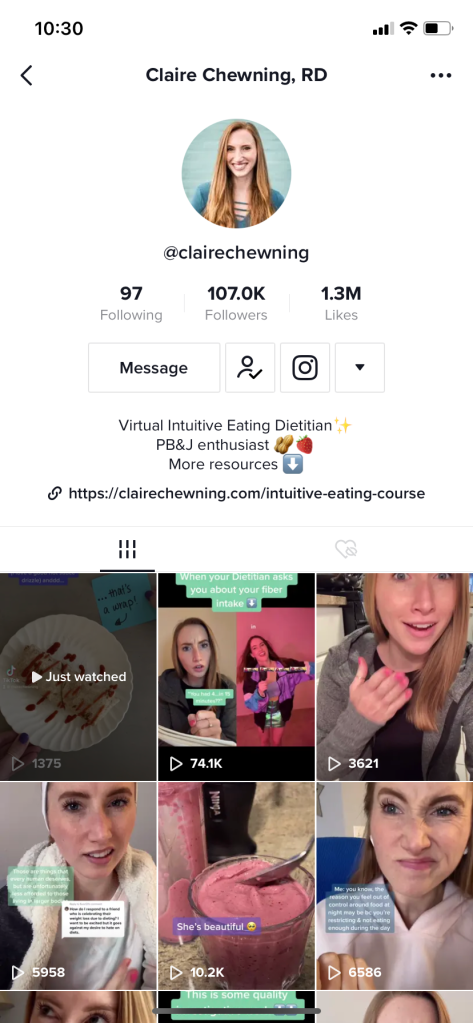
A registered dietitians with real facts on good nutrition and listening to your body. Love her!
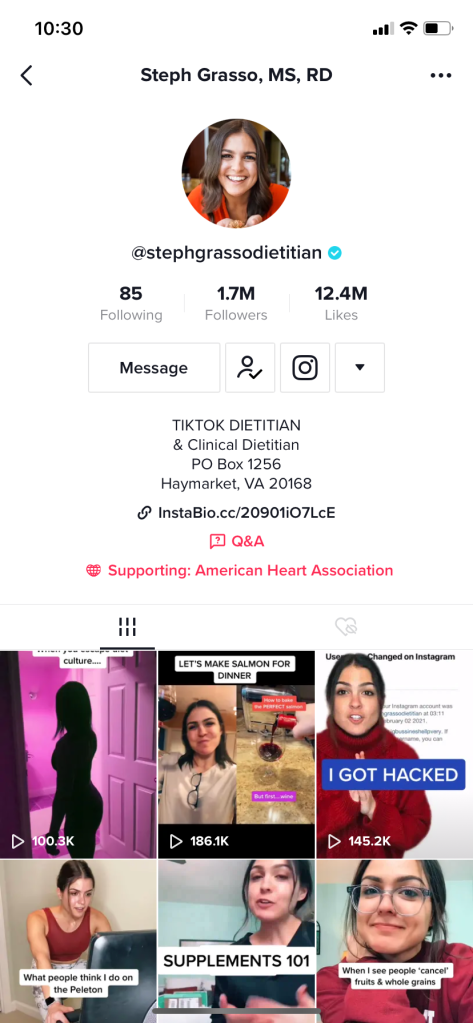
Another fab RD who knows what she’s talking about. She also has fun with TT trends. Don’t judge.
After 45 years on this planet as a female, this OB/GYN is literally the one who told me things I never knew. 100% recommend her page.

Feeding the Mind

Politics, history, current culture, faith. These are creators provide necessary content for today.

If you don’t know Quentin, get to know him. A follower of Christ who walks the walk and gives you straight talk on politics and doing the right thing.
He’s intro’d himself as that pastor from Oklahoma who voted for Biden. He doesn’t mince words about what it means to authntically follow Christ and how that influences voting and life.
It’s that type of stuff that makes great conversation starters and helps you remember there is still good in the world.
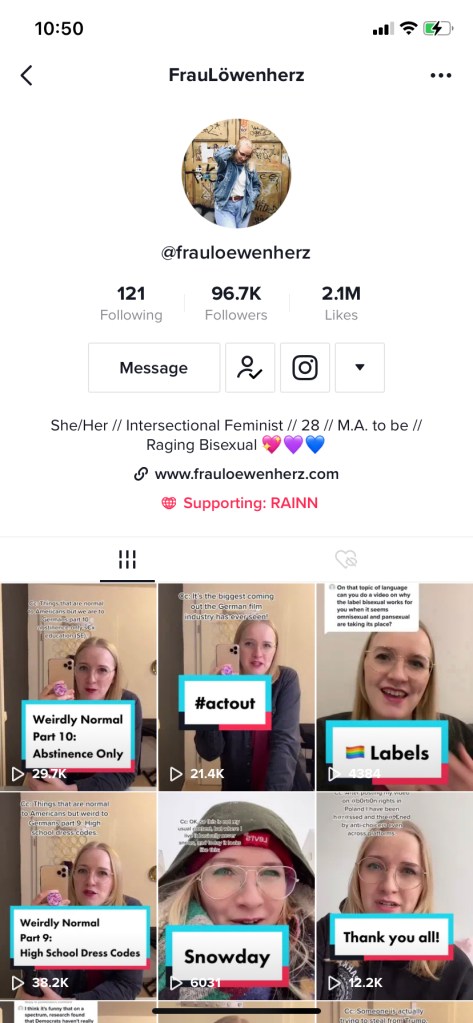
Fascinating insights on American politics, culture, and history from someone outside the U.S. who knows what she’s talking about.

For Fun

These creators just make me laugh, smile, and say “whoa.” There are a lot of them out there to discover, but these are favorites.

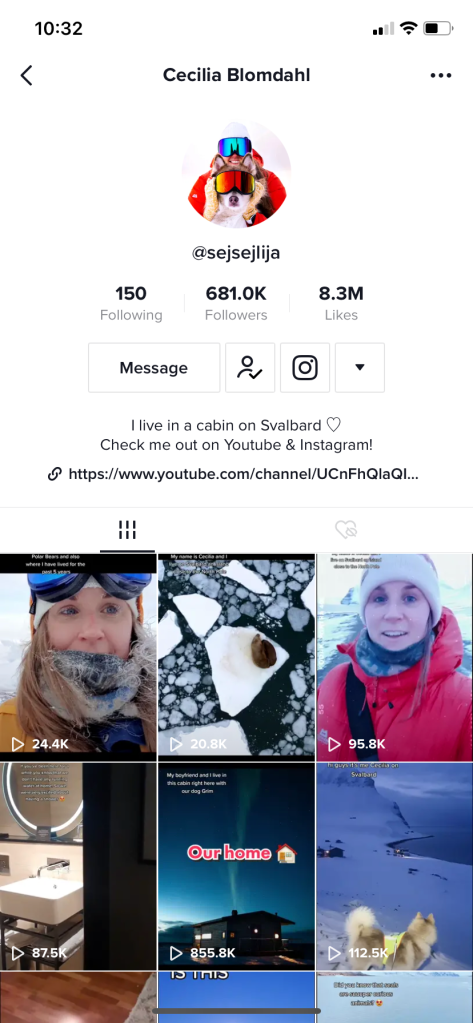
This woman lives on an island near the north pole where polar bears roam around and there is no light for four months out of the year. Her page is just cool.
This child and her mom are adorable. Both have recently gone internet-famous for morning affirmations they do together, which we all could benefit from repeating.
His guitar playing is sooooo good. He also made to Jimmy Fallon for playing background Uke music while his brother got busted by his mom. Very cool content.
Last, but not least, Meg, the South Asian student who’s delivery and unabashed accent as the best! Shaddap! #IYKYK

So there you have it! If Tik Tok brightens your day during these very tough days, don’t be ashamed! Right now, to keep laughing and learning is the best we can do.

When People Say “I Don’t See Color”

I don’t see color.”

Really? That’s sad. Really sad. So, you don’t notice a bright crimson cardinal flitting through avocado-green leaves on a spring day? You can’t tell the difference between MAC Ruby Woo and Russian Red? Was your wedding dress purple when you thought it was champagne? Or if you are very light complected and after hours and hours of cooking yourself in the blazing sun, you have no idea that your efforts have only made you an angry shade of dusty rose as opposed to the sun-kissed bronze you’ve been working for (Also, don’t do it. Embrace your color—or lack of—before you get skin cancer and wrinkles)?

So, when you see a person of color do you fail to see the beautiful skin tones in every shade from onyx to café au lait? Because if that’s really the case, you live a very sad, bland, and boring existence. Or you have a medical condition that must be addressed (please address it). Because in pretending to see the world in muted shades of gray you fail to see something that is so blatantly diverse, it is literally popping with striking varieties of color everywhere you look.

I get what is trying to be said with those words. But here’s why that statement is not only false, it’s really not helpful.

Saying you don’t see color denies the color of a person and actually upholds racism because that notion erases who they are. (https://www.oprahmag.com/life/relationships-love/a32824297/color-blind-myth-racism/). I can hear the “But Dr. King wanted a world where his children would be judged by the content of their character and not the color of their skin, so I teach my children to see people for what they are and not what color they are.” I know what Dr. King said. And this is true—every human being should be regarded for who they are rather than what they look like. But Dr. King wasn’t talking about disregarding the Blackness of his children or the Brownness and Whiteness of their friends.

It’s perfectly ok to notice a person’s skin color and/or ethnicity or to even notice the variations in a person’s outward appearance to ask about their ethnic background. That should be noticed, and it should be acknowledged. It’s all good provided your noticing of and asking questions regarding that comes from a place of kindness and genuine interest in the person as a human being (and if the questions sounds ignorant, you can apologize), and of course, is not inappropriate.

To acknowledge that a fellow human being is a different color than you or has a unique look about them is vitally important. It affirms the beauty in the unique background that person comes from, whether because they hail from a certain part of the world or because they are a gorgeous mix of several parts of the world. I believe human beings are uniquely created beings, not colorless souls bopping around this planet. Their race or blending of races is intrinsically a part of who they are. You can’t dismiss that in hopes that by professing to not notice skin color you are doing a person some holy favor. You are only diminishing one of the most important parts of what makes them great.

Listen, “having racist thoughts does not make you a racist but failing to question your racially-based assumptions does.” (https://www.rd.com/article/why-you-should-stop-saying-i-dont-see-color/). You notice when you enter a room and, in the people, represented there are lots of colors that are different from yours. And that can cause you to make assumptions about where you are, what you are there for, and what the people surrounding you are really like. If you are doing that, you need to address it. Because denying that shows you are actually working harder to look away from a piece of someone’s humanity over anything else. And that’s not right.

See the color. Acknowledge it. Embrace it. Endeavor to understand all that it represents. And most of all, respect it.

You do see color.

America Doesn’t Exist in a Vacuum: Part 2

This is part 2 and the conclusion of a discussion I had with Leonie, a German political, historical, and cultural social media creator and graduate student in American Studies. After watching one of her (very accurate) posts I was immediately interested in her observations about our (completely nutty) politics in light of the events of the past four years. Leonie’s insights are astute and very telling; something Americans would be well served to pay attention to.

Wilo:

The growth of the far-right movement in Germany, and clearly here in America. How do you interpret the connection? Trump’s ability to embolden hate groups through his rhetoric—what has that done in your country?

Leonie:

I do think it’s all kind of interconnected. I remember something I found really, really telling. When the Alt-Right party in Germany had their “national meeting,” which of course they had to do in person, because who would do it online during a global pandemic? There were people there wearing Trump 2020 masks. This is the only party that is represented in any parliament that openly supports Trump. They don’t criticize him at all. I’m pretty sure members from every party here so far have only criticized Trump, even our conservative party.

This is a global thing. I have family in Spain and England and friends in Scotland. Everyone that I have talked to, we are all seeing this everywhere in Europe, and yeah in America the far right has gained traction. The night of the insurrection at the capitol I spoke to a colleague of mine, we were like ‘Are you watching this?’ I was watching the Senate debates on C-Span and suddenly something was happening. I switched to a news channel and called and texted colleagues. One of them, who is in critical race theory, said ‘we’ve been saying this for years.’ But you know, we were all ‘snowflakes.’

Wilo:

People see this and ask, ‘Where is all this coming from?’ What do you say about that?

Leonie:

This is a development that we’ve seen before Trump, absolutely. In Germany, way before Trump. I think one of the central problems that we are dealing with is people saying, ‘where is all this racism, anti-Semitism coming from?’ It was never gone. It was never smaller. It has always been there. I’ve seen this coming for years, and I’ve been seeing this shift to the right for years. I do think that in Trump it has found the loudest voice yet. And through the Trump presidency, it has also found legitimacy.

Wilo:

There are many in America who say it was actually Obama who fed the flames. What do you think about that? Do you think the Obama years solely gave the far right the shove they needed?

Leonie:

It’s kind of the same thing as saying ‘where is the racism coming from?’ It was there all along. It was there before Obama. It was there before the Dixiecrats. We can go back, and back, and back in history. So, I do think that a very loud and very radical minority felt threatened by the Obama administration. They felt threatened in their privilege. No, they felt threatened in something they didn’t know was a privilege, and I think most of them still don’t know that.

But if you’re so used to the people in power always looking like you, and never being surrounded with anyone that doesn’t look like you, and never having to empathize with people who don’t look like you; and then someone comes in who doesn’t look like you but now they are going represent you, you feel that this is threatening your way of life, your superiority and that can readily radicalize people.

You still have a lot of people who feel forgotten and then legislation comes in pushing affirmative action, pushing immigration, etc. They feel like they’ve been waiting in line for so long and people are coming and cutting in front of them. And that is the exact narrative that Trump tapped into—the forgotten people. He legitimized their feelings and their fears, no matter how irrational they were and that needs to be addressed in the future. That’s not just going to go away.

Wilo:

So, with the election of Joe Biden and Kamala Harris, and this very multi-cultural, multi-gendered, multi-aged cabinet, if you were to guess, do you think things are going to get better for us?

Leonie:

I mean, it’s hard to make predictions. I definitely hope so. But this has multiple, multiple steps to it. First of all, I can tell from German history, the past needs to be addressed.

Republicans are calling for unity right now. This is what worries me in these calls echoed by some Republicans and even by Biden. If there’s someone in the field and you’re pretty far from each other and you want to meet in the middle, you move a few steps toward them. But then they move a few steps back and tell you meet in the middle. And that’s basically what the Republican party is doing. Democrats now are where Republicans were a few decades ago.

The United States in general is much further right then Germany, for example. I cannot think of one U.S. representative on a federal level that would be considered left by German standards.

Wilo:

Not even Alexandria Ocasio-Cortez?

Leonie:

She would probably be in the social democratic party, but that’s not the left party here. Her views and what she wants [for the U.S.] are standards here. Even our right-wing party wouldn’t dare to call for abolishing universal healthcare.

Wilo:

Back to this hope for unity. Is there really hope?

Leonie:

These calls for unity. Where do you draw the line? With the capital insurrection, wasn’t that the one line crossed where you say, ok. No. That’s a huge problem. I do think a lot of problems could be solved through proper education. If you look at certain history books, there’s a lot of work to be done. It shocked me that are still parts of the United States where its taught that the Civil War was basically about state’s rights.

We all have chapters in our history that aren’t addressed. I think that talking about these issues builds empathy and gives you a much different perspective from these types of discussions. There is so much to be done.

[In addition to the past needing to be addressed], I think the democratic party as a whole needs to reposition itself, and to be completely honest, I don’t think that the political system and the election system, the way it’s working or not working right now in the U.S.—I don’t think can be reformed. The two-party system, gerrymandering, the general election, how districts are drawn, it’s just the entire system. I mean the systemic racism alone that is entrenched in this system can’t be reformed. It all needs to be broken down and built up again. And I don’t think that is going to happen. So, yeah. I’m not super optimistic. I, of course, hope for the best, but I’m prepared for the worst.

Wilo:

You made a video that I was intrigued with, where you talked about the perception of America in Germany and abroad, that we are not this stronghold of democracy anymore. Can you expand on that?

Leonie:

Especially among conservatives, there’s this self-perception of American as this world leader, and it’s something you’ve had for a very long time. We’ve had the United States basically play the world’s police. So, if you take on this position as a global superpower than you also have to deal with the global criticism. This self-understanding of the United States especially by conservatives on the right and far right. It’s just American exceptionalism on the political world stage. Whereas a lot of countries are watching the U.S. right now and we are worried.

We see that a lot of people don’t have healthcare. There’s a homeless crisis going on. And what we see is a country that is unwilling to invest in its people and to invest in growth; that’s more worried about outward appearances internationally than its own people. Let’s hope that changes with this new administration. I don’t want to put anyone down. If I thought that everything about the U.S. sucks, I wouldn’t have dedicated by career to it. I also think that criticism is a form of love. If I didn’t care about the U.S., I just wouldn’t care.

If things continue the way they are right now, the U.S. is going to implode at some point. And that’s in regard to politics, to race relations, in regard to basically every level that you can possibly think of. Things need to change soon. This perception of the U.S. as this global superpower that other countries can only aspire to, um, that has changed. The EU also had a large role in this. Europe is starting to work more and more closely together.

The United States is the last developed country that doesn’t grant its citizens universal healthcare. That’s a medical crisis alone.

Someone posted something along the lines of: “If the U.S. was seeing what the U.S. is doing to the U.S., the U.S. would invade the U.S. to install democracy in the U.S.” I think that summed up the situation pretty well.

***

And on that very apropos note, I hope this has given you something to think about.

A key takeaway for why it’s important to hold our country up to doing better? “Criticism is an act of love.”

True patriots can see the bad about themselves and work for good.
America Doesn’t Exist in a Vacuum: Part 1

This is part 1 of a discussion I had with Leonie, a German political, historical, and cultural social media creator and graduate student in American Studies. After watching one of her(very accurate) posts I was immediately interested in her observations about our (completely nutty) politics in light of Biden’s recent inauguration and the events of the past four years leading up to it. Leonie’s insights are astute and very telling; something Americans would be well served to pay attention to.

What does everyone think of me?” Aaahh the question of a million middle and high schoolers navigating puberty, growth, change, and the next steps that lay ahead of them. It’s a question important to people of that age, though the older influences in their lives try to impart the futility of caring too much about the answers. But you still want to know. Sometimes you find out that the issues about yourself you were so worried about aren’t even registering with others. Other times you discover there are many things you need to pay more attention to.

It’s not that different in the life of a nation. Especially if your name is the United States of America. Though the administration of the last four years tried to pretend America stood alone with no reason to care about other countries sharing this planet, those very countries have indeed cared about what we were doing. And they have been watching.

Is the United States of America still regarded as an everlasting bastion of democracy on the world stage? What have the last four years done to our reputation? Read on to find out.

Wilo:

So, where did your interest in America, American culture, and our politics and history come from? Why pursue graduate work in American Studies?

Leonie:

The reason I’m doing what I’m doing is probably influenced by the pop cultural influences I had as a kid and teenager. Our pop culture in Germany is heavily influenced by American pop culture. I learned English from watching American shows streamed in English and not being afraid to speak it. The older I got, I got an emotional connection and spent some time in the U.S. I took part in a jazz music exchange twice as a teenager. But as I grew older and became more politically active and just political in general, I of course had an interest in the political side of the country I was so fascinated with.

Wilo:

What’s been the perception of the United States and its politics in Germany?

Leonie:

[Speaking of the Trump years for example], what a lot of Trump supporters making comments to my content just don’t get is that what Trump did not just affect the United States. Pulling out of the Paris Climate Accord affected us. All of the sudden, in a matter of days, pulling troops out of Germany affected us. Germany stores weapons for the United States and the history and the relationship of these two countries just makes it impossible to think the U.S. just exists in a vacuum.

I can’t speak to how Germany in general perceives the United States but thinking of the Obama administration or Obama running for president and the pop cultural influences and all that. It all played into this idealized perception of America. Now the more you get involved in that, the more research you do, the more people you meet, it gets clearer that this is not the case, but this is also what gets me.

Wilo:

What is the news cycle like in Germany in terms of covering American politics?

Leonie:

The major headlines do make their way over to Germany. German news works very differently than it does in the United States. We do have news channels, but they are in no way, shape, or form comparable with American news organizations. We do have publicly funded television and publicly funded news, which are very matter of fact. I would say it covers 50% German news and 50% from around the world, and the U.S. is in there.

Wilo:

Let’s talk about when Donald Trump first burst on to the political scene and announced his run for president. Did you keep track of that?

Leonie:

Yeah, absolutely back then. I was doing my bachelor’s work so was already very interested in all of that. We did follow and I think it was similar to what most Democrats and a lot of Republicans felt at the time: that no one should take him seriously. We’re not taking him seriously. Then it got to the point where he was the Republican nominee and we saw this. Now with the German history we see things through that lens and can see a certain rhetoric. I know it worried us for sure, because we’ve seen this, and we’ve seen this from the right-wing party in Germany. We’ve seen that you don’t even have to win the race to shift the political discourse.

We’ve seen this in Germany now. They are a minority but through existing in the public discourse they have brought back a rhetoric that was deemed unacceptable before. And that is what we saw during the Trump candidacy. And that was what really worried us—that people all of a sudden felt comfortable saying racist, homophobic, ableist, sexist, misogynistic things in public.

Wilo:

When you woke up to the November 9, 2016 news that Trump had won, what was your reaction, and that of the German public that you could see?

Leonie:

So, this year we didn’t have a viewing event at the university in the American Studies department, which is something do every presidential election, except for during a global pandemic. [In 2016], I stayed until 11 or midnight and I was really emotionally exhausted. I went to bed relatively early that night because I knew it was going to take some time. But I went to bed feeling optimistic because at that point, Hillary Clinton was still in the lead. I felt like, you know what? I’m going to wake up tomorrow morning and the U.S. is going to have its first female president. This is awesome. But then there as already this voice in my saying, don’t be so sure.

I woke up pretty early the next morning and grabbed the remote control to turn on the TV, only to see the last few electoral votes coming in that pushed Trump over the finish line. And I started crying because I knew that this affected so many people. I remember I saw the other day in my archives, something I posted on Instagram that has been so shockingly true. I posted something like people are going to lose their insurance, their healthcare, their lives, their dignity, their homes, their safety. I didn’t know I was going to be that right. I wish I wasn’t.

That morning I had to go to a seminar on American politics or American institutions or something like that. And overall in the department it was very, very, quiet. You could feel there we were all in collective shock. So, I can only imagine what it felt like in the U.S.

Stay tuned for Part 2!

Polite Girls Can Be Impolite

As someone from an Eastern culture who highly values manners, respect for elders, and polite behavior in all people—children to adults—I can relate to those who have either been fed a fallacy or propagated behaviors that don’t serve the young girls/women in our lives. And that has got to stop in this one very important arena: the creepy man vs. the nice girl.

If, like me, you were raised in an ethnic tradition that is highly patriarchal, you’ve grown up to know a few things. You NEVER call an adult by their first name. They are either Uncle or Aunty, or Mr. and Mrs. Even if they insist you call them by their names, you know better than to do that, so you fall back on calling them Mr. Adam or Miss Helen or something like that. But that only works for Western cultured people. You never call your parents by their first names unless you have a death wish (long into adulthood I should add), and you defer to your elders in many situations.

Along those lines, you have also been taught to smile politely and keep your thoughts/opinions to yourself in the face of a grown person saying anything that doesn’t sound right to you. You never correct or question them in public and your best course of action is to make yourself scarce as soon as can be politely allowed. Sure, this leads to many Eastern cultured children being praised as extremely well behaved and delightful in the eyes of random adults, but there’s a dark side to this that a lot of us have experienced.

I believe this behavior primes young girls (and boys too) to be vulnerable to disgusting men (and sometimes women). When an uncle (by name or because of actual relation) says something inappropriate, makes comments about your body or looks, or touches you without permission (yes, even something as minor as a hug), girls need to sound a verbal warning bell with no apologies. This is especially vital in a patriarchal culture. More important, parents need to unequivocally back them up.

How many of us have been at the receiving end of weirdness by older males, either family friends or actual relatives, that have said or done things that are inappropriate? I’m raising my hand here. I’ve had a male relation comment that I had nice thighs when I was 15. I’ve had another male relative who took over my room when visiting comment that my sheets smelled womanly. I was 13. Thankfully, worse did not happen. But those examples shouldn’t have happened either. What was my response? I smiled. Even with the thighs comment (why is a grown, married father looking at a 15 year-old’s thighs?) I actually said, “Thank you.” Had I stood up for myself by even saying, “You shouldn’t say those things to me, or showing my disdain with eye rolling (which I’m really good at), I would have surely been busted by my parents.

So, here’s where the narrative has to change. Our girls (and boys) need to know that predators are real and can be found anywhere—even in our families. They should never have to feel they must politely receive inappropriate behavior of any kind from someone. They need to know that we, as their parents, grandparents, guardians, aunt, uncles, and older friends; will believe them and have their backs. Our kids need to also know that no one is allowed to touch them, even for a hug, without their permission—even if they are toddlers. Adults should always ask a child if they can give them a hug, and if the child says no—even because they are being ornery—you never force your “affection,” upon them. Fist bump, elbow bump, shake hands, and such. But the child involved makes the ultimate decision on whether your physical affection is something they are ok with. The autonomy belongs to them.

I recently watched a Tik Tok where two little girls were singing a song about not being polite to creepy men (and yes, I was inspired). Right on, little girls and the parents raising them! I sent the video to a friend with a four-year-old daughter, telling her this was so important to impart. I didn’t have to worry, it appears. My friend told me her child at age 3, was trick or treating for Halloween and at the home of someone the family knew. The uncle there touched the top of her head and gave her a blessing. She immediately turned to him and said, “Why did you touch me?” She asked her mom, “Why did that man touch me? I don’t know him.” And Boom. This child clearly know that she is the owner of her body, and no one does anything without her permission. That right there is exactly what needs to happen.

It’s easy to warn our children about strangers or even people they sort of know. But the waters get muddied when it comes to family or friends—especially in ethnic communities. And this is exactly where things need to be crystal clear. This is exactly when you need to let your child know they are free to be impolite and downright rude if they have to, to any grown person who does or says something that makes them feel icky. And they need to know you will always support them.

Have you had to smile and nod when someone was inappropriate to you? What do you think about allowing your kids this “impolite clause” within the realm of the good manners you are trying to teach?